
Introduction
Personality traits are often classified into five factors in a model called the Big Five. McAdams et al. (2021) explain that the Big Five refers to five traits: neuroticism, extraversion, openness, agreeableness, and conscientiousness. Each of these traits is unique and has characteristics that define a person’s behavior. Openness is one of the five primary personality traits that define an individual’s character.
Slobodskaya (2021) defines the openness trait as a person’s willingness or ability to engage in intellectual and imaginative activities, always seeking to think outside the box. It defines how open-minded, creative, insightful, and imaginative an individual can be, especially when seeking a solution to a given issue. Those with this personality are known to prefer routine. It means they like having a specific plan for doing things and for relating to people around them (Sala, 2021). They also prefer practical solutions to challenges that they or their organizations face. Although they understand the power of imagination, they know that a practical solution is more effective for addressing a problem.
It is necessary to define the concept of intelligence and understand how it relates to openness as a personality trait. Intelligence refers to an individual’s ability to acquire knowledge and skills and apply them across various settings and contexts (Dijk et al., 2020). There is a general belief that childhood intelligence may predict a person’s openness in adulthood.
In children, intelligence can be measured by how well they grasp a concept taught in class and by their overall exam performance. A highly intelligent child may become an open-minded, creative, imaginative individual who is always seeking unique solutions to the challenges they face. It means that a person’s ability to succeed in life can be predicted early in life by assessing their intelligence.
In this paper, the researcher seeks to investigate and evaluate the personality trait of openness, primarily examining the extent to which childhood intelligence predicts openness in adulthood. The key areas of focus throughout the paper include the historical development of the 5-factor model, a detailed discussion of openness traits, an outline of childhood intelligence and its relationship to openness as a personality trait, and a conclusion summarizing the investigation’s findings. The above-mentioned items will serve as the key themes or topics on which the debate in this essay will be based.
Research Aim and Question
Personality and intelligence are concepts that have attracted the attention of scholars over the past several decades. Silverman and Patterson (2021) argue that when a study focuses on a widely researched topic, it is often advisable to specify what needs to be achieved. This study aims to explain and evaluate the personality trait of ‘openness’. The following is the primary question that has to be answered by the end of this project:
- To what extent (if any) do measures of childhood intelligence predict levels of ‘openness’ in adulthood?
Discussion
Historical Development of the 5-Factor Model
Personality traits and how they develop in childhood have become popular topics among psychologists seeking to explain why people behave in certain ways. Dijk et al. (2020) argue that there are five primary personality traits, which include neuroticism, extraversion, conscientiousness, agreeableness, and openness, as shown in Figure 1 below. Understanding the historical development of the 5-factor model would require an analysis of the theories that led to its creation. The lexical hypothesis is one such theory that helped develop this model.
The theory states that, over a given period, shared constructs of self-perception are encoded in natural human language. Other theories further developed the model. Sir Francis Galton’s Theory argues that specific human traits are more beneficial to a person’s intelligence because of evolution. When faced with a specific challenge, a person behaves in a given way based on their personality traits. One person would likely run when threatened, while another might fight back. An individual may exhibit traits from two or more of the classes listed in the figure.
A wide range of factors shapes a person’s personality, and theories have been developed to explain this. Allport’s theory holds that a person’s personality is largely influenced by childhood experiences, current environment, and interactions (Bernstein et al., 2022). The theory helps in establishing the relationship between a personality trait and intelligence.
Cattell’s theory holds the argument that a person is innately driven by their ergs, the desire to address hunger, anger, curiosity, fear, or any other fundamental motivation (Slobodskaya, 2021). It explains why people would behave in a given manner when faced with a specific situation. Costa and McCrae’s theory is what led to the five factors, sometimes called the Big Five traits or OCEAN (Openness, Conscientiousness, Extraversion, Agreeableness, and Neuroticism) (Sala, 2021). Their theory led to the classification of personality traits into 5 major categories, as shown in the 5-factor model below.
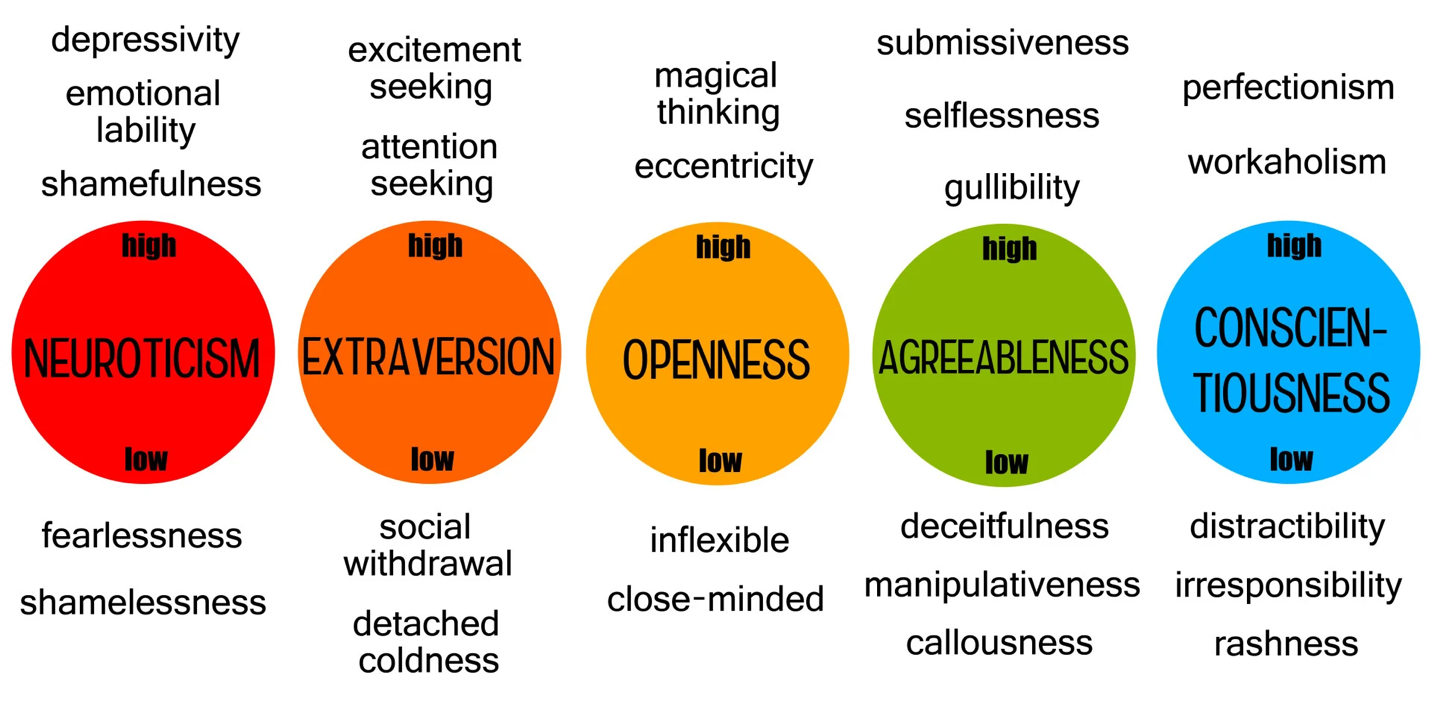
Openness is one of the most attractive personality traits, especially in an organizational setting where creativity and openness are needed to address both common and new challenges. Although they may be inflexible on their lows, most of the time these individuals are willing to try new ways to address challenges and prefer working closely with their colleagues (Lim, 2023). It is of great interest to learn how an individual becomes open-minded, from early childhood to adulthood. Studies have shown a link between childhood intelligence and openness as a personality trait.
Slobodskaya (2021) and Dijk et al. (2020) argue that highly intelligent children are more likely to exhibit this personality trait in adulthood than their less intelligent peers. They learn, from an early age, the importance of involving others when solving a problem. As they grow up, they acquire the creative skills needed to solve different problems (Slobodskaya, 2021). Beyond their performance in class, it is difficult to measure a person’s ability to develop this trait at a young age. One cannot accurately predict whether a young person will retain their creativity as an adult.
Evaluation of the 5-Factor Model and the Openness Trait
The section above has outlined various theories and how they led to the development of the 5-factor model. The big-five models, as derived from the lexical hypothesis, have strengths and weaknesses worth noting at this stage. The strength of this approach is that it was based on wide research, focusing on 18,000 terms to describe a person’s behavior, traits, and personality (Sala, 2021).
The fact that different theorists have developed concepts that support the model is another strength of the approach. However, the main weakness is that an individual’s behavior cannot be strictly defined into the five classes (McAdams et al., 2021). A person may exhibit traits that belong to two or more of the five classes.
The terminology used in the Big Five or early lexical hypothesis approaches may be translated into other cultures or languages. However, Slobodskaya (2021) notes that challenges often arise during translation. The actual meaning intended in the early lexical-hypothesis approach may be lost when it is translated into another language.
In other cases, the term may not make sense in a given cultural setting (Bernstein et al., 2022). Despite these challenges, it is important to note that the Big Five model and openness, as one of its major personality traits, have clear theoretical backing. The theories explained above all support the argument that personality can be categorized into the five primary classes.
The trait of openness accurately predicts a person’s behavior. One of the traits of such a person, as identified in this model, is being spontaneous in their actions (McAdams et al., 2021). It may not be easy to predict the actions of such individuals when faced with a specific challenge. It has also been established that open-minded managers tend to be flexible when faced with new challenges. They are willing to listen to different people’s views and always make their decisions based on practicality.
The Big Five may be able to capture more complex, context-specific traits that an individual may possess because of its comprehensive approach to development. However, it is important to acknowledge that it does not capture all personalities (Sibley & Osborne, 2022). This is especially important when cultural factors and the loss of meaning due to translation are considered.
Other cultures have defined personality traits in fundamentally different ways that do not fall into the Big Five model. The fact that the terms used in the model vary across cultures means the Big Five may not apply effectively to individuals in different cultures. However, the model can help in predicting their behavior, especially how they are likely to respond to various environmental stimuli.
Selecting the five key traits makes sense when defining a personality because they define how a person’s behavior can be uniquely classified. As mentioned above, some personality traits can correlate with one another. For instance, it is possible to find cases where openness and extroversion traits intersect. This is a case where these two different personalities share some characteristics.
The fact that these traits correlate does not mean it would make sense to collapse them into one group, which would result in fewer traits (Slobodskaya, 2021). This is because most traits are not shared, so one trait may not accurately describe a person’s behavior. The best option would be to conduct more research to provide more traits that would provide a more accurate picture of personality.
Outline of Childhood Intelligence
It is necessary to understand the history of intelligence measurement in children. Various theorists have developed different ways to measure intelligence in people, especially children. Galton’s theory holds that specific physical attributes, such as hearing capacity, eyesight, and grip strength, serve as indicators of a person’s intelligence (Sala, 2021). The argument seems to be supported by Spearman’s theory, which holds that a person’s general intelligence is directly correlated with their personal abilities (McAdams et al., 2021).
Binet’s theoretical concepts have gained massive acceptance among many psychologists because of their effectiveness in measuring an individual’s intelligence. In this theory, an individual’s IQ is calculated by dividing the mental age by the chronological age, then dividing the quotient by 100 (Kalechstein et al.). Using Binet’s test, the assumption is that 100 is the average IQ. A score below 1 indicates a below-average intelligence, while a score above 100 indicates above-average intelligence IQ (McAdams et al., 2021). This measurement has been widely used to assess children’s IQ.
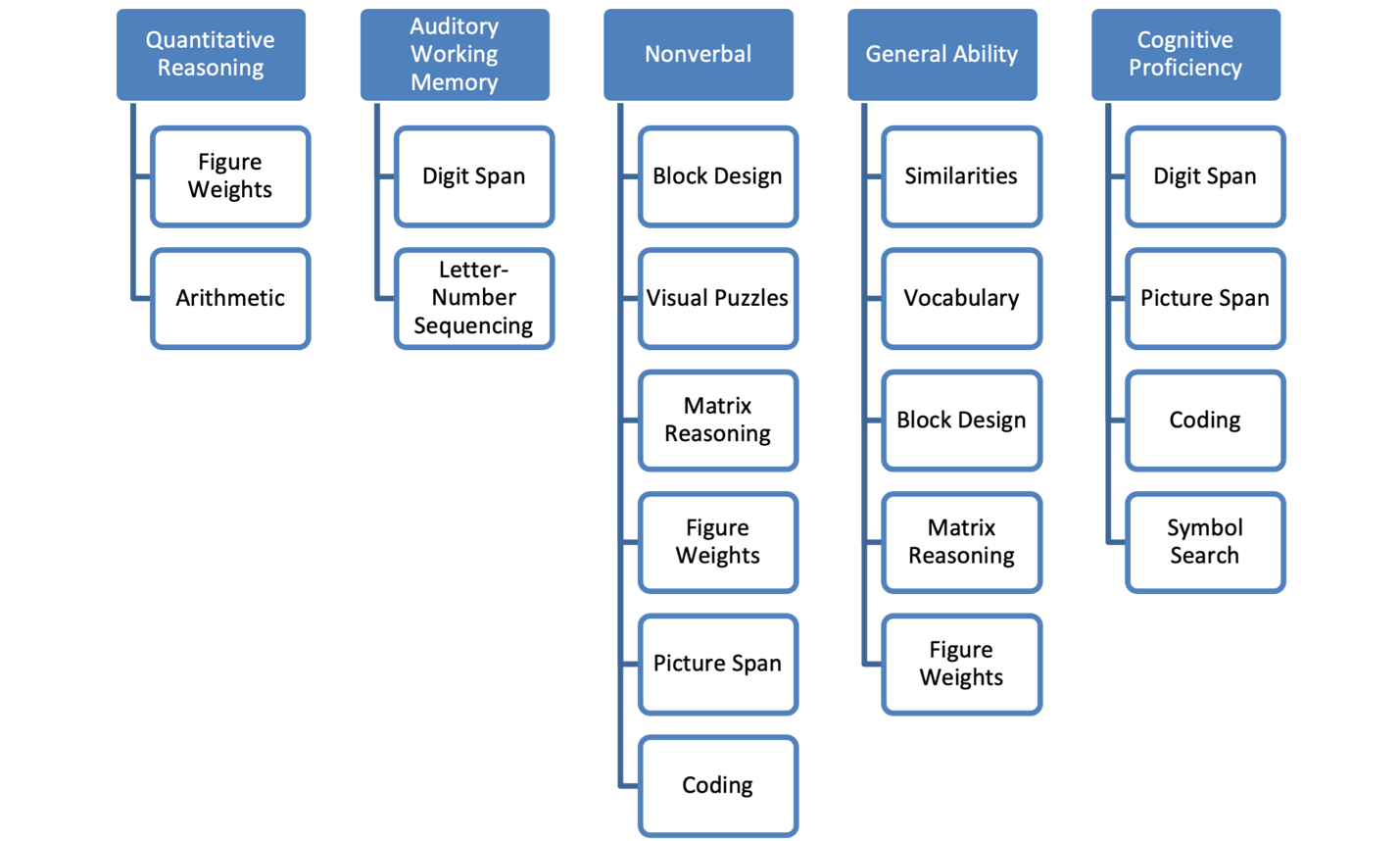
Some modern tests have emerged to help measure a child’s intelligence. One of them is the very popular Wechsler Intelligence Scale for Children (WISC). When using this model, one needs to assess intelligence at four different stages, as shown in Figure 2 below. The first level is quantitative reasoning, which focuses on arithmetic, weights, and figures (Haslam & Smillie, 2022).
The second level is auditory working memory, which focuses on letters, numbers, sequencing, and digital span. Then there are the non-verbal skills such as coding, picture span, block design, visual puzzles, reasoning, and matrix (McAdams et al., 2021). The next level is general ability, which assesses vocabulary, similarities, block design, reasoning, matrix, figure, and weights. The last level is cognitive proficiency, which focuses on symbol search, picture span, digital span, and coding.
Cattell’s outline of fluid and crystallized intelligence is a much more modern approach to measuring intelligence among children. It defines fluid intelligence as the ability of an individual to process new information (data), learn from it effectively, and then use it to solve various problems (Sibley & Osborne, 2022). Crystallized intelligence, on the other hand, refers to an individual’s stored knowledge (data) accumulated over the years (Kalechstein et al., 2021). Using this outline, a child’s intelligence can be measured by their ability to use both fluid and crystallized intelligence to solve problems. Cattell’s theory emphasizes a person’s ability to apply the knowledge they acquire to address problems or challenges they encounter.
It is important to assess the validity and reliability of these two intelligence measures. The four-level model is considered comprehensive for assessing children’s intelligence. It looks at various aspects of intelligence, including non-verbal skills. Cattell’s theory focuses on a student’s capacity to acquire new knowledge, store it, and then use it to solve various forms of problems that they may encounter. Generally, they serve as the basis for most academic tests, making them reliable and valid.
The four-level test assumes that tests of specific intelligence would be equally applicable across cultures. Although the strategy is not influenced by stereotypes that may affect performance, it raises ethical concerns because cultural differences may lead to different outcomes. Cattell’s theory addresses this ethical challenge by not defining learning in a culture-specific way. It creates room for flexibility depending on one’s cultural background.
Argument for Childhood Intelligence Predicting Openness
There is a general argument that childhood intelligence may predict openness as a personality trait later in a child’s life. It is necessary to identify a theory that supports this argument. Numerous theories explain children’s intelligence and personality traits throughout development. Cattell’s investment theory posits that childhood intelligence may predict openness in a child’s later life. This theory holds that fluid intelligence in children leads to the development of crystallized intelligence (McAdams et al., 2021).
As a child grows, their fluid intelligence helps develop their crystallized intelligence. The crystallized intelligence will then dictate how an individual behaves, especially how they solve problems encountered in adulthood. It means that high childhood intelligence (fluid intelligence) would lead to behavior that satisfies cognitive hunger, as they would have enhanced crystallized intelligence. Their general traits will therefore fit the description of openness as a personality trait.
Studies have suggested that the intelligence of a child is likely to define their personality as an adult, just as Cattell’s theory suggests. A study by Benmira and Agboola (2021) aimed to determine if leaders are born with specific, unique traits. They collected data from primary sources and conducted a qualitative analysis. Their findings revealed that the unique attributes that define a leader are learned rather than innate. They concluded that environmental factors and a child’s intelligence play a leading role in shaping a child’s personality as an adult. Their study supports the theory above, which means that intelligence may predict openness.
Verhaar et al. (2022) also conducted a study to determine factors in childhood that would lead a child to become a criminal as an adult. They conducted a longitudinal study using secondary data sources. Their findings reveal that most criminals learn these undesirable behaviors from the environments in which they grow. As they watch criminals get rewarded, they are gaining fluid intelligence. The fluid intelligence would then become crystallized intelligence as they acquire these dangerous skills to help them achieve what they desire in life. It shows a correlation between childhood intelligence and openness in adulthood.
It is necessary to critically analyze the evidence above that shows the relationship between childhood intelligence and openness in adulthood. The research aligns with the plaster theory, which holds that a person’s personality is set in the early stages of development. The strength of the research discussed is that they were based on empirical studies conducted over a long period.
Slobodskaya (2021) explains that there is a wide range of evidence supporting the argument that a child’s intelligence not only defines personality but also predicts later-life success. (McAdams et al., 2021) also contend that some of the hardened criminals learn from an early age that they can succeed in life by bending or breaking the law. As a result, knowledge crystallizes in their minds, and they develop a personality characterized by crime.
It is worth noting that the research discussed above had some weaknesses. A study by Verhaar et al. (2022) was correlational, meaning it ignored causal factors that define an individual’s personality. For instance, specific events in a person’s life may redefine their personality. Haslam and Smillie (2022) note that a specific event can occur to a person in adulthood that can completely erode the crystallized knowledge they acquired in childhood.
For instance, a person who is insightful and open to new ideas may suddenly change when faced with a major betrayal in adulthood. They learn later in life that some traits they cherished as children have no place in a highly competitive, manipulative real-life environment (Sibley & Osborne, 2022). The main weakness of the argument is that it ignores the possibility that a single major life experience can significantly change an individual’s personality for the rest of their life. Despite these weaknesses, it is important to note that the evidence describes the general pattern by which an individual’s personality develops from childhood, assuming there are no major events that would significantly impact them.
Argument Against Childhood Intelligence Predicting Openness
The preceding discussion presents a strong argument for a link between childhood intelligence and adult openness. However, several theoretical perspectives suggest that childhood intelligence does not inevitably determine openness later in life. Among these, the social construction of reality theory challenges the assumption that early cognitive ability directly shapes openness in adulthood.
This theory holds that people’s reality is created and often shaped by their interactions (McAdams et al., 2021). It explains that when a person enters a new environment, they may experience culture shock as they struggle to adjust. For some time, they will try to maintain the personality they acquired in the old environment. In this case, they will exhibit openness as their underlying personality trait. If they realize that this trait is not sustainable in their current environment and that it is making their lives unbearable, they will change in response to the new realities.
This theory is supported by the heliotropic hypothesis, which holds that social systems evolve towards the most desirable or positive images (Kalechstein et al., 2021). Sometimes changes may be slow and systematic, while in other cases they may be sudden. In this case, the personality trait influences their intelligence. The desire to improve the system makes such individuals spend more time on activities that help them acquire more knowledge, thereby becoming more intelligent. In this case, their intelligence influences their personality rather than the other way around.
Many studies have questioned the claim that childhood intelligence predicts openness later in life. A study by Anglim et al. (2022) investigated the relationship between personality and intelligence. One of its aims was to investigate how an individual’s personality shapes their level of intelligence. The article was a meta-analysis that relied wholly on secondary data. The findings of this study show that the relationship between openness and intelligence is more complex than initially outlined in prior studies.
They concluded that numerous factors influence an individual’s personality. It also emerged that one’s personality would define one’s level of intelligence. For instance, an individual may become resilient and highly motivated in what they do because of their socio-economic background. It means that when they focus on their studies, their dedication makes it easier for them to succeed. In such cases, their intelligence would be attributed to their personality. This evidence supports the argument that our personalities may change over time in response to encounters.
The evidence supporting the argument has strengths and weaknesses worth discussing at this stage. The main strength of the evidence is that it is a peer-reviewed article based on practical evidence. Studies by Cerni et al. (2021) and Benmira and Agboola (2021) emphasize that people change their behavior at different stages of life in response to various encounters. It means that their childhood intelligence would not rigidly define their personality as adults.
Some of the world’s worst dictators were influenced by specific events that reshaped their personalities. Despite the study’s strength, it is necessary to acknowledge its weaknesses. As mentioned above, the study was a meta-analysis that relied solely on secondary data sources. The absence of primary data meant this report could not independently verify some of the claims made by other scholars. Primary data is often the most effective way to address knowledge gaps in the existing literature.
Conclusion
Childhood intelligence is correlated with openness in adulthood, as discussed above. The study shows that a highly intelligent child is likely to acquire unique traits that would define their personality as adults. Their high level of intelligence makes them highly inquisitive about life. They have a desire to learn more about their immediate environment.
As discussed above, insightfulness is one of the major traits of openness. These individuals are always willing to work closely with people who may have divergent opinions from their own. They understand that there is no single fixed way to develop knowledge, and that people sometimes interpret reality differently depending on factors such as political or cultural differences.
As such, they are open to embracing different realities. As a child, they encounter fluid intelligence through normal learning in the classroom and in their social environment. With time, fluid intelligence condenses into crystallized intelligence. The crystallized intelligence would then influence these individuals’ openness in adulthood.
It should be emphasized that several studies seriously question the notion that childhood intelligence predicts openness in adulthood. They argue that a person’s personality significantly influences their level of intelligence. Based on factors that define a person’s intelligence, it emerged that only individuals who are committed and focused can acquire knowledge that makes them appear intelligent. Without commitment and focus, the individual would lose focus and may not amount to anything in their adulthood.
For such a child, it may not be possible to predict how their childhood will shape their personality in adulthood. They may later rely on other forces to define the path they consider relevant and desirable. In other cases, an intelligent child may be affected by various environmental factors that end up redefining their personality in adulthood, a pattern that differs from what had been predicted.
Both arguments are contradictory, but present strong evidence that makes them believable. However, the researcher must draw a conclusion based on the facts presented, weighing the evidence. Based on the findings, this research concluded that childhood intelligence is one of the leading factors that define openness in adulthood. When all factors are held constant, which in this case means that all the other influencers are ignored, then childhood intelligence would directly lead to openness in adulthood.
However, in real life, it is not possible to ignore the other factors. One must accept that as a child grows, they will encounter major events that may significantly redefine their personality. If they were intelligent as a child, they would try to embrace openness as much as possible. The degree to which they will deviate from this personality will depend on the magnitude of the negating experience, the period within which it was felt, and how rewarding they felt it was.
References
Anglim, J., Dunlop, D., Wee, S., Horwood, S., Wood, J., & Marty, A. (2022). Personality and intelligence: A meta-analysis. Psychological Bulletin, 148(5), 301-336.
Benmira1, S., & Agboola, M. (2021). Evolution of leadership theory. British Medical Association Journal, 5(1), 1-7.
Bernstein, D., Marsico, G., Zumbach, J., & Narciss, S. (Eds.). (2022). International handbook of psychology learning and teaching. Springer International Publishing.
Cerni, T., Benedetto, A., & Rumiati, R. (2021). The contribution of personality and intelligence toward cognitive competences in higher education. Frontiers in Psychology, 12(1), 1-9.
Dijk, M., Hale, W., Hawk, T., Meeus, W., & Branje, S. (2020). Personality development from age 12 to 25 and its links with life transitions. European Journal of Personality, 34(3), 322-344.
Haslam, N., & Smillie, L. (2022). An introduction to personality, individual differences and intelligence. SAGE Publications.
Kalechstein, A., Nowicki, S., & Iles-Caven, Y. (Eds.). (2021). Locus of control: Antecedents, consequences, and interventions using Rotter’s definition. Frontiers Media SA.
Lim, A. (2023). Big five personality traits: The 5-factor model of personality. Simply Psychology.
McAdams, D., Tackett, J., & Shiner, R. (Eds.). (2021). Handbook of personality development. Guilford Publications.
Sala, D. (Ed.). (2021). Encyclopedia of Behavioral Neuroscience. Elsevier Science.
Sibley, C., & Osborne, D. (Eds.). (2022). The Cambridge handbook of political psychology. Cambridge University Press.
Slobodskaya, H. (2021). Personality development from early childhood through adolescence. Personality and Individual Differences, 172(1), 1-11.
Verhaar, S., Mathewson, M., Bentley, C. (2022). The impact of parental alienating behaviours on the mental health of adults alienated in childhood. Children, 9(4).