
Introduction
Organizational charts provide a clear path for all stakeholders involved in the service a project aims to deliver and ensure a sound framework has been established to support it. For this paper, a structure for a program revolving around psychotherapeutic assistance for clients with addictive disorders is proposed. It is essential to ensure that such an entity is flexible to accommodate the complexity of personalized interventions.
Program Identification and Capacity
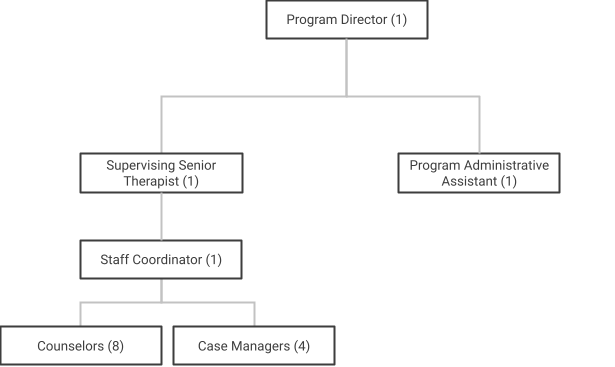
Psychotherapeutic programs require a significant investment in each person’s case due to the need to construct a personalized strategy that will motivate them to turn to abstinence. Both group and individual sessions must be considered, despite the increased need to prepare specialists to operate in different settings (Adams, 2020). The intended program will leverage professionals’ abilities to alleviate the burden of addictive behavior from individuals while considering the full extent of their problems. Given the company’s size in Figure 1, its capacity will be limited to 40 patients to ensure counselors can provide sufficient coverage for each person.
Staff Qualifications and Credentials
The qualifications of the specialists involved in this project must adequately cover the capabilities required for each position. First and foremost, management of such a framework requires administrative professionals to ensure the program’s compliance with regulations, timely fulfillment of clients’ needs, and a long-term plan to remain competitive in the market. Furthermore, managerial positions in this structure must cover not only the aforementioned needs but also personnel demands and professional growth opportunities (Calley, 2011).
Specialists at the top of the hierarchy must possess a degree in business administration, although the company’s size ensures that the complexity will not be excessive. Except for the senior therapist, other workers who will interact with clients may be less experienced in practice, though their counseling degrees will be vital. The rationale for this selection is the need for counselors to be adaptable. Additionally, autonomous decisions in each case are essential for therapists, as they have the closest connection and understanding of the program’s clients (Finsrud et al., 2021). Therefore, individual schedules may need to be considered.
Scheduling
The caseload size for such a company must remain within reasonable limits for each available specialist. A maximum of 5 cases per specialist on the same day will be assigned, as each situation requires in-depth analysis and thorough preparation for the session. Each meeting will last an hour, allowing full-time workers to spend sufficient time analyzing each patient’s course. Case managers can alleviate a significant portion of counselors’ assessment-related needs (Adams, 2020).
The scheduling patterns for personnel must incorporate their personal and professional needs, as well as the situations of their appointed clients. Managerial staff can provide input on a part-time basis if necessary, since the firm is small, enabling them to assign work hours as needed to meet deadlines. A senior professional will be called weekly to analyze progress and assist with challenging cases and ethical dilemmas. The rest of the employees will be working a full week.
The Logic Model and the Organizational Chart
The relationship between the organizational chart and the logic model prioritizes the steady progress of clients enrolled in this program. Since the company’s operations are based on psychotherapeutic treatment, it follows the pattern of problem identification, intervention, short- and long-term outcomes, and evaluation of results (Calley, 2011). It will be essential to track which approaches are selected for each individual and how the company can further enhance its impact through its employees’ combined expertise. To this end, the chart in Figure 1 ensures that staff interactions align with the client-oriented vision that is crucial to such projects.
Organizational Culture
Communication within the team is critical for the success of its operations. While horizontal connections are essential to this program, such as the shared workload between case managers and therapists, it remains vital to ensure accountability within the group. Therefore, a vertical hierarchy will be employed to ensure that senior professionals can provide timely supervision and feedback to other employees. Each worker’s accountability will lie in their successes on cases and the time they take to fulfill their duties for clients.
However, supervision in the form of progress reports regarding each enlisted in the program must be integrated into the system. Staffing must be performed to meet client needs and to adhere to the standards for such organizations. Ideally, the company’s culture should focus on autonomy and cooperation in knowledge sharing and assistance with complex cases, thereby solidifying the entire framework into a cohesive whole.
Conclusion
In summary, the provided organizational structure is essential for the outlined program due to its scope and field of operations. Psychotherapeutic interventions require significant flexibility from personnel, which puts pressure on all employees, as they must be able to cover a range of treatment formats. The primary workload will be placed on professionals who will work directly with clients.
However, the administrative assistant and the program director will play a role in each case’s success. The qualifications listed for the selected positions ensure that both the administrative and operational aspects of this program are adequately covered. The modified chart guarantees that autonomy will not be detrimental to patients. If the team establishes a work environment that supports communication as described in the paper, the operation’s success will be ensured.
References
Adams, S. (2020). Psychotherapeutic approaches for addictions and related disorders. In P. K. Wheeler (Ed.), Psychotherapy for the advanced practice psychiatric nurse: A how-to guide for evidence-based practice (3rd ed., p. 711–748). Springer.
Calley, N. G. (2011). Program development in the 21st century: An evidence-based approach to design, implementation, and evaluation. SAGE Publications.
Finsrud, I., Nissen-Lie, H. A., Vrabel, K., Høstmælingen, A., Wampold, B. E., & Ulvenes, P. G. (2021). It’s the therapist and the treatment: The structure of common therapeutic relationship factors. Psychotherapy Research, 32(2), 139-150.